Prediction markets have become a new route for confidential corporate information to leave a company. This post explains how that happens, why the usual controls miss it, and how invisible forensic watermarking helps show who knew what.
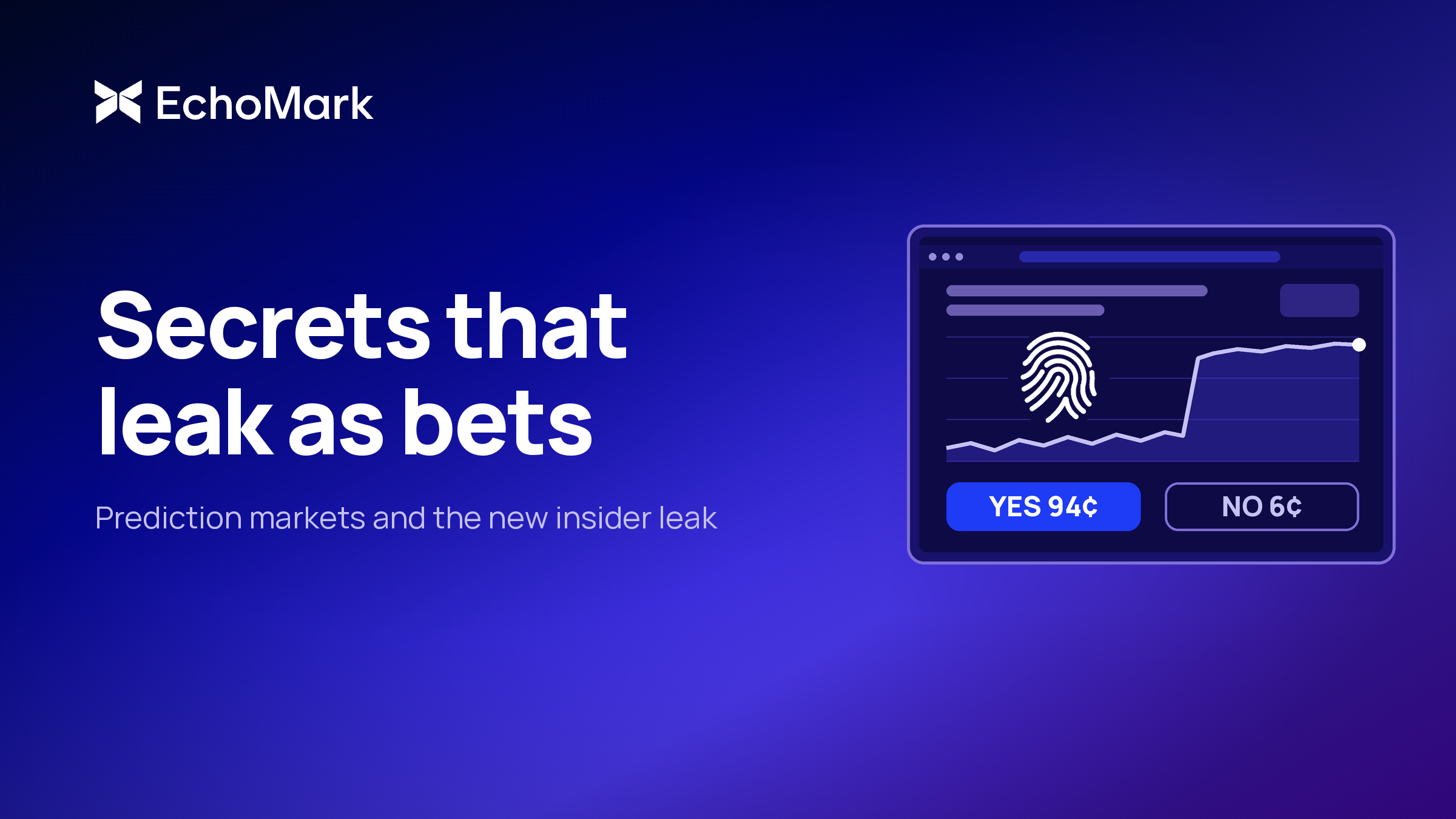
Prediction markets have become a new way for confidential corporate information to leak. On platforms such as Polymarket and Kalshi, an employee who knows a product's launch date or an upcoming announcement can bet on it from a phone. When enough money moves at once, the shift in the odds can tell the public what's coming before the company announces it.
In 2026, employees have been fired, banned, and criminally charged over bets on product launches, upcoming listings, and internal company data. Each case starts the way any leak does, with information that was supposed to stay inside the company getting out. For security and compliance teams, that puts a premium on being able to show who knew what, when they knew it, and whose copy a leaked version came from.
The obvious route is the bet itself. Someone who knows the outcome trades on it, and confidential information has been used outside the company for personal gain.
The bet also sends a signal. Prediction market prices are public, and a sudden wave of money behind an unlikely outcome tells observers that someone may know something. Polymarket's CEO, Shayne Coplan, said in 2025: "I think what is cool about Polymarket is that it creates this financial incentive to divulge information to the market." When market watchers act on that signal, the information is effectively public before the company chose to release it.
The person who places the bet also isn't always the person who knew. Apple's updated insider trading policy tells employees: "You must also not tip Apple Confidential Information to others who may participate in such markets." Hollywood studios have issued similar guidance that covers tipping friends and family.
A secret has to travel from the insider to the bettor somehow. Sometimes it's a conversation. Often it's a forwarded email, a screenshot of a launch timeline, a photo of a slide from an internal review, or a document shared with a colleague who was never on the original distribution list. Each of those is a copy of the information that left the person it was given to, and a copy that was marked before it went out can be traced.
Most of the cases reported in 2026 involve ordinary corporate events rather than quarterly results:
Skadden's note for boards also cites markets on "the expected release date for a new mobile phone with advanced features" and on "whether GameStop will acquire eBay." Leadership changes fit the same pattern. Company insider trading policies such as DocuSign's list "top management or control changes" and "major new products" as inside information, and leadership memos already leak to the press regularly. The November 13, 2026 edition of This Week in Leaks included two.
Insider trading controls were designed around financial results and the executives who see them early. Blackout windows, preclearance, and brokerage statement reviews all assume that the sensitive information is a number in an earnings report and that the people who know it are a short, known list. Prediction markets break both assumptions.
The information looks harmless. A launch date, a casting decision, a product listing, or an internal ranking doesn't feel like inside information to most employees, and it rarely appears on a restricted list. Yet each of these has been the subject of a bet, and in some cases a criminal charge.
Far more people have access. A product launch date can pass through engineering, product, marketing, legal, partner, and support teams before it's announced, and a reorg plan can reach HR, finance, and every manager affected. In the Google case, the data was available through a tool open to every employee. When hundreds of people know something, a compliance team can't rely on a list of executives to work out who might have bet on it.
The trail starts with an anonymous account. Investigators work back from a pseudonymous wallet to a person and then have to show that the person knew. That depends on having an accurate record of who had the information and when.
Policy tells people what they may not do, but it doesn't tell you who knew. When a suspicious bet surfaces on a launch date or a leadership change, most organizations have to rebuild the list of who had that information from memory, calendar invites, and email threads. That list is usually incomplete, because a launch plan gets forwarded to a colleague, a reorg memo gets screenshotted into a group chat, and a deck shown in a meeting gets photographed.
Invisible forensic watermarking embeds a unique, imperceptible identifier in each recipient's copy of an email, document, or on-screen view. The mark is part of the content itself, so it survives forwarding, screenshots, printouts, photos of a screen, and retyped text. That does three things for prediction market leaks:
Watermarking can't detect a bet, and it can't trace information that never left as a copy, such as a conversation. It works alongside policy and trading surveillance, which define what's prohibited and flag suspicious positions.
EchoMark applies invisible forensic watermarking across the channels sensitive plans travel through. EchoMark Email marks each recipient's copy of a message. EchoMark File Share marks each copy of a shared document, and its activity history shows who downloaded one. EchoMark Screen marks what appears on screen, so a photo of a monitor carries the viewer's identity. When a copy leaks, EchoMark identifies whose copy it was in minutes. Schedule a demo to see how EchoMark shows who received your most sensitive plans and traces a leaked copy back to its source.
-----