A leaked CAD file or product spec can hand a competitor years of R&D in an afternoon. EchoMark turns your leak investigation from weeks of inconclusive work to definitive answers in minutes — with forensic evidence and chain-of-custody documentation.
Get a DemoManufacturing and design organizations make significant investments in engineering effort and R&D to develop the products that define their competitive position. That investment is crystallized in CAD files, product roadmaps, technical specifications, and supplier communications, but can become worthless the moment it surfaces in a competitor's product line or at a trade show.
EchoMark is built to protect this investment throughout the product development lifecycle. Every design document, technical brief, and supplier communication is automatically watermarked — invisibly, individually, and without disrupting existing engineering workflows. No change to the tools teams use. No additional software for recipients. When IP surfaces where it shouldn't, EchoMark already has the answer.
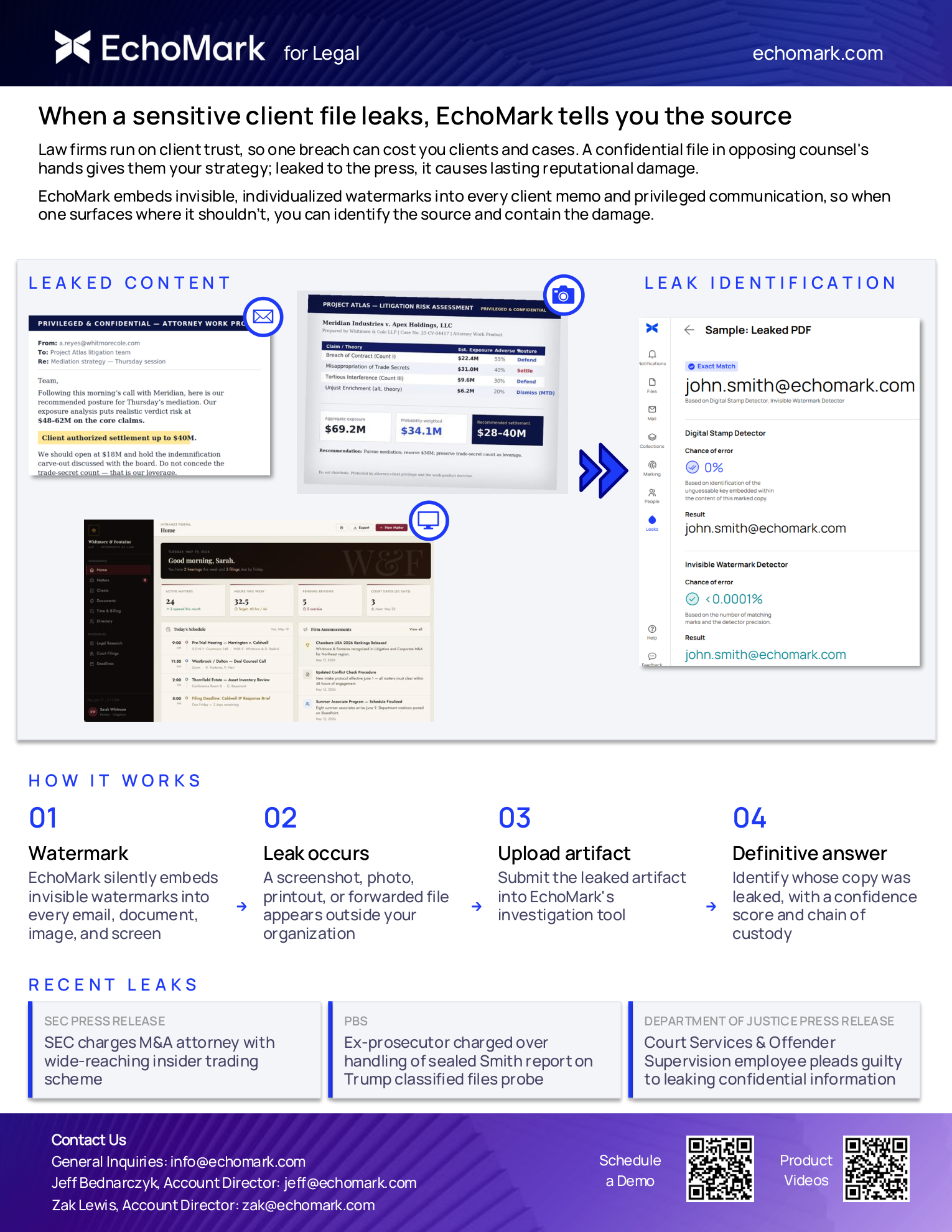
Individualized invisible watermarks offer a discreet yet robust safeguard for design documents, technical specifications, and supplier communications used across the product development lifecycle. By embedding unique identifiers imperceptible to the human eye, EchoMark deters unauthorized sharing of product roadmaps, engineering specs, and proprietary formulations. It also enables you to trace leaks back to the source when they do occur.
What EchoMark can protect:


When a design file surfaces at a trade show, in a competitor's product, or in a leaked spec sheet, submit the artifact — a screenshot, a photo of a screen, a printout, even quoted text — and EchoMark's investigation tools identify whose copy leaked. What once took weeks of inconclusive investigation can now be resolved in minutes.
EchoMark can trace a leak from:
EchoMark's forensic identification is built to stand up to scrutiny. Chain-of-custody documentation, a confidence score, and tamper-resistant watermarking are designed to support evidence that holds up if your organization needs to act — pursuing recourse against a bad actor, supporting a law-enforcement referral, or demonstrating due diligence to regulators.
Every leak report includes:


EchoMark silently embeds invisible watermarks into every email, document, image, and screen.

You discover a sensitive screenshot, photo, printout, or file outside your organization.

Upload the leaked artifact to EchoMark's investigation tool to identify whose copy leaked, with a confidence score and chain of custody.


How do manufacturing companies identify who leaked a design file or product spec?
EchoMark embeds an invisible, individualized forensic watermark in every copy of a document or email distributed within a manufacturing organization. When a design file surfaces in a competitor product or at a trade show, the organization uploads the leaked artifact and EchoMark matches it to the single recipient whose copy it came from, usually within minutes, with a confidence score.
Can a product roadmap or CAD file leak be traced if someone photographed the screen or took a printout?
Yes. EchoMark's watermarks are designed to survive screenshots, photos taken of a screen, printing, and photocopying — so a leaked design can often be traced to its source even when it doesn't leak through digital channels.
How do companies protect trade secrets from employees and suppliers?
Because every recipient — whether an engineer, supplier, contractor, or partner — receives a uniquely marked copy, there is no anonymous copy to hide behind. That individual accountability deters careless or intentional sharing. Uniquely marked copies follow documents shared beyond the organization, so material that travels to suppliers or vendors remains attributable to the recipient who received it.
What should an organization do when a product spec or trade secret leaks?
Preserve the leaked artifact exactly as it was found, whether a photo, screenshot, printout, or copy-paste, then upload it to EchoMark to determine whose copy it was. The result includes chain-of-custody documentation and a confidence score the organization can use to decide how to respond: internally, with legal counsel, or through law enforcement.
How is forensic watermarking different from DLP for manufacturers?
Data loss prevention (DLP) tries to block files from leaving and often interrupts legitimate collaboration, yet it can't tell an organization who leaked something once it's out, and it doesn't work when someone photographs a screen or prints a document. Forensic watermarking takes a different approach: engineers and suppliers keep working normally since the marks are invisible and don't interrupt workflows. Every copy is individually attributable because the marks are in the content itself.
Can a leak be traced if the content was altered or the file was reformatted?
Often, yes. EchoMark applies marks designed to persist through edits, format conversions, and incomplete images, so attribution does not depend on the leaker capturing the entire file or preserving the original file format.
See how EchoMark can be seamlessly integrated with your Microsoft Exchange or Google Workspace to automatically embed invisible watermarks in messages, images, and documents.


