Invisibly watermark client memos, privileged communications, filings, deal documents, and exhibits to trace leaks back to the source.
Schedule a DemoSeamlessly protect privileged information without disrupting how your attorneys work. EchoMark's individualized invisible forensic watermarks protect every client memo and privileged communication. No complex tools, processes, or training required.
Download Info Sheet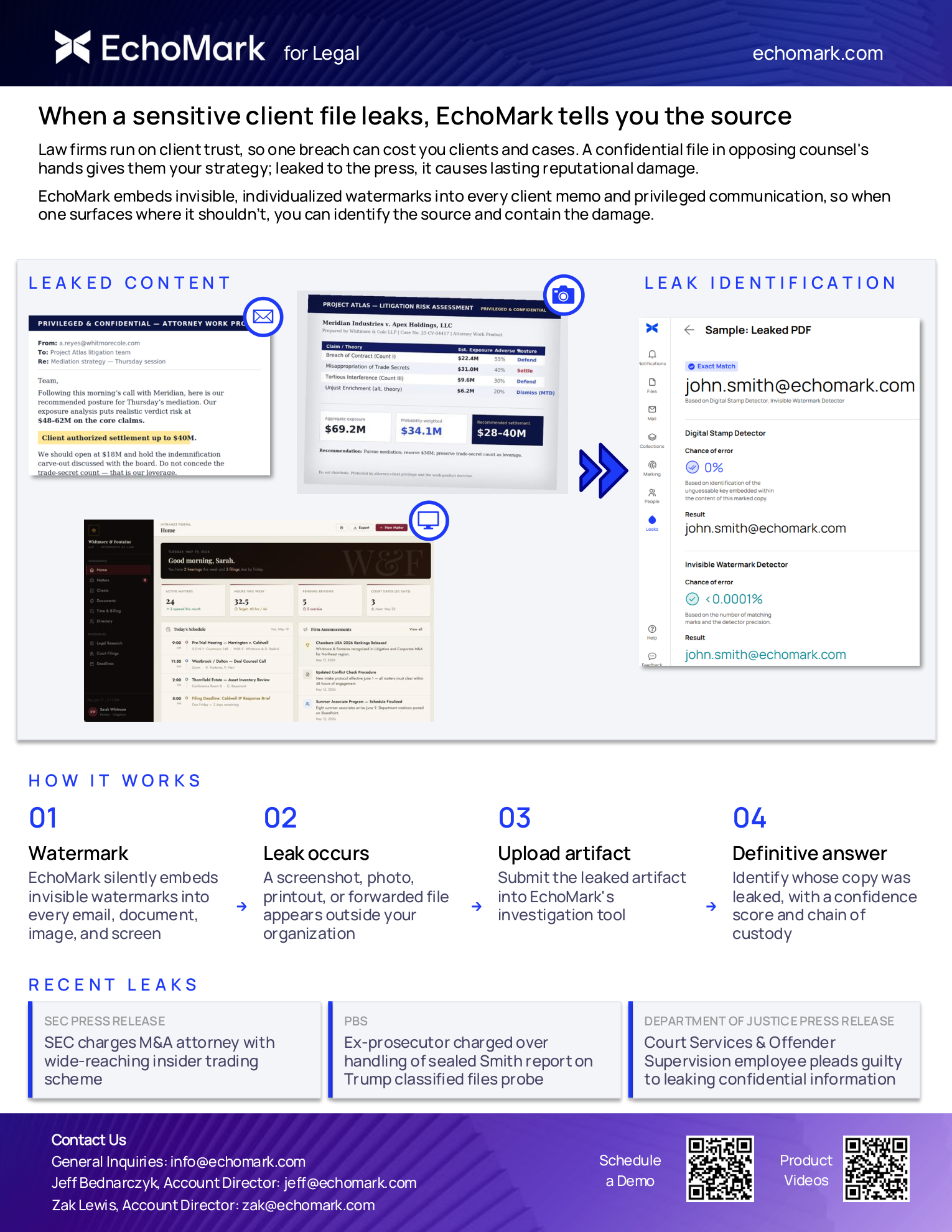
Individualized invisible watermarks offer a discreet yet robust safeguard for the privileged communications, client memos, and work product your firm handles every day. By embedding unique identifiers imperceptible to the human eye, EchoMark deters unauthorized sharing of case strategy, deal terms, filings, and exhibits before a leak ever happens, and enables you to trace leaks back to the source when they do occur.
What EchoMark can protect:


When a confidential file surfaces where it shouldn't, submit the artifact - a photo, printout, even retyped text, and EchoMark's investigation tools identify whose copy leaked. What once took weeks of inconclusive investigation can now be resolved in minutes.
EchoMark can trace a leak from:
EchoMark's forensic identification is built to stand up to scrutiny. Chain-of-custody documentation, a confidence score, and tamper-resistant watermarking are designed to support evidence that holds up if your firm needs to act - pursuing recourse against a bad actor, supporting a law-enforcement referral, or demonstrating due diligence to clients.
Every leak report includes:

EchoMark silently embeds invisible watermarks into every email, document, image, and screen.
A screenshot, photo, printout, or forwarded file appears outside your organization.
Submit the leaked artifact into EchoMark's investigation tool.
Identify whose copy was leaked, with a confidence score and chain of custody.


How do law firms identify who leaked privileged documents?
EchoMark embeds an invisible, individualized forensic watermark in every copy of a document or email a firm distributes. When a privileged file surfaces where it shouldn’t, the firm uploads the leaked artifact and EchoMark matches it to the single recipient whose copy it came from, usually within minutes, with a confidence score.
How do legal teams prevent privileged documents from being leaked?
Legal teams typically rely on information barriers, strict DMS access controls, and NDAs to limit exposure, but none of these tell you what happens once a document leaves the firm’s direct control. EchoMark closes that gap. Every privileged memo, work product draft, or deal document receives a uniquely watermarked copy per recipient - invisible to the eye, but readable by EchoMark’s computer vision. If a document surfaces in an unauthorized press report, a leaked deposition exhibit, or an eDiscovery dispute, the firm can upload the artifact to identify which recipient's copy leaked with a confidence score and chain-of-custody documentation to support a bar complaint or internal disciplinary action.
Can a leak be traced if someone photographed the screen or printed the document?
Yes. EchoMark’s watermarks are designed to survive screenshots, photos taken of a screen, printing, and photocopying, so a leaked file can often be traced to its source even when analog league methods are used.
What should a firm do after a privileged document leaks?
Preserve the leaked artifact exactly as it was found, then upload it to EchoMark to determine whose copy it was. If the document was marked, the investigation summary can indicate which copy was leaked, including with chain-of-custody documentation and a confidence score the firm can use to decide how to respond.
How is forensic watermarking different from DLP?
Data loss prevention (DLP) tries to block files from leaving and often interrupts legitimate work, yet it can’t tell a firm whose copyo was leaked once it’s out. Forensic watermarking takes the opposite approach: attorneys keep working normally, and every copy stays individually attributable after the fact.
Can EchoMark protect documents shared with co-counsel, experts, and vendors?
Yes. Uniquely marked copies follow documents shared beyond the firm, for example with co-counsel, local counsel, experts, e-discovery vendors, and clients. Information that travels outside the firm’s walls remains attributable to the recipient who received it.
See how EchoMark can be seamlessly integrated with your Microsoft Exchange or Google Workspace to automatically embed invisible watermarks in messages, images, and documents.


