Invisibly watermark earnings materials, deal documents, investment memos, and trading strategies to trace leaks back to the source.
Get a DemoSeamlessly protect confidential financial information without disrupting how your analysts, bankers, and deal teams work. EchoMark's individualized invisible forensic watermarks protect every earnings preview, deal document, investment memo, and client communication. No complex tools, processes, or training required.
Download Info Sheet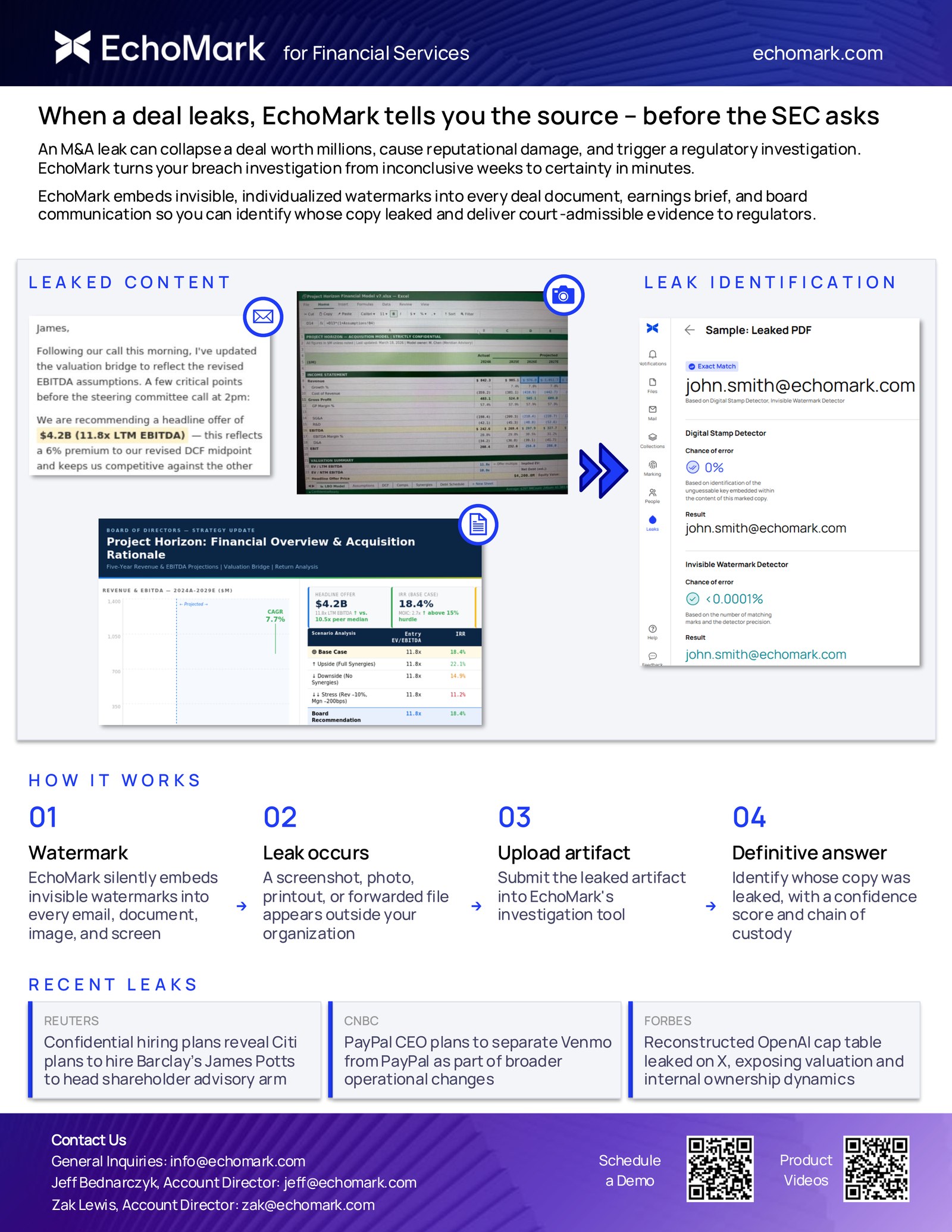
Individualized invisible watermarks offer a discreet yet robust safeguard for the pre-announcement figures, deal documents, investment memos, and portfolio materials your firm handles every day. By embedding unique identifiers imperceptible to the human eye, EchoMark deters unauthorized sharing of material nonpublic information before a leak ever happens, and enables you to trace leaks back to the source when they do occur.
What EchoMark can protect:
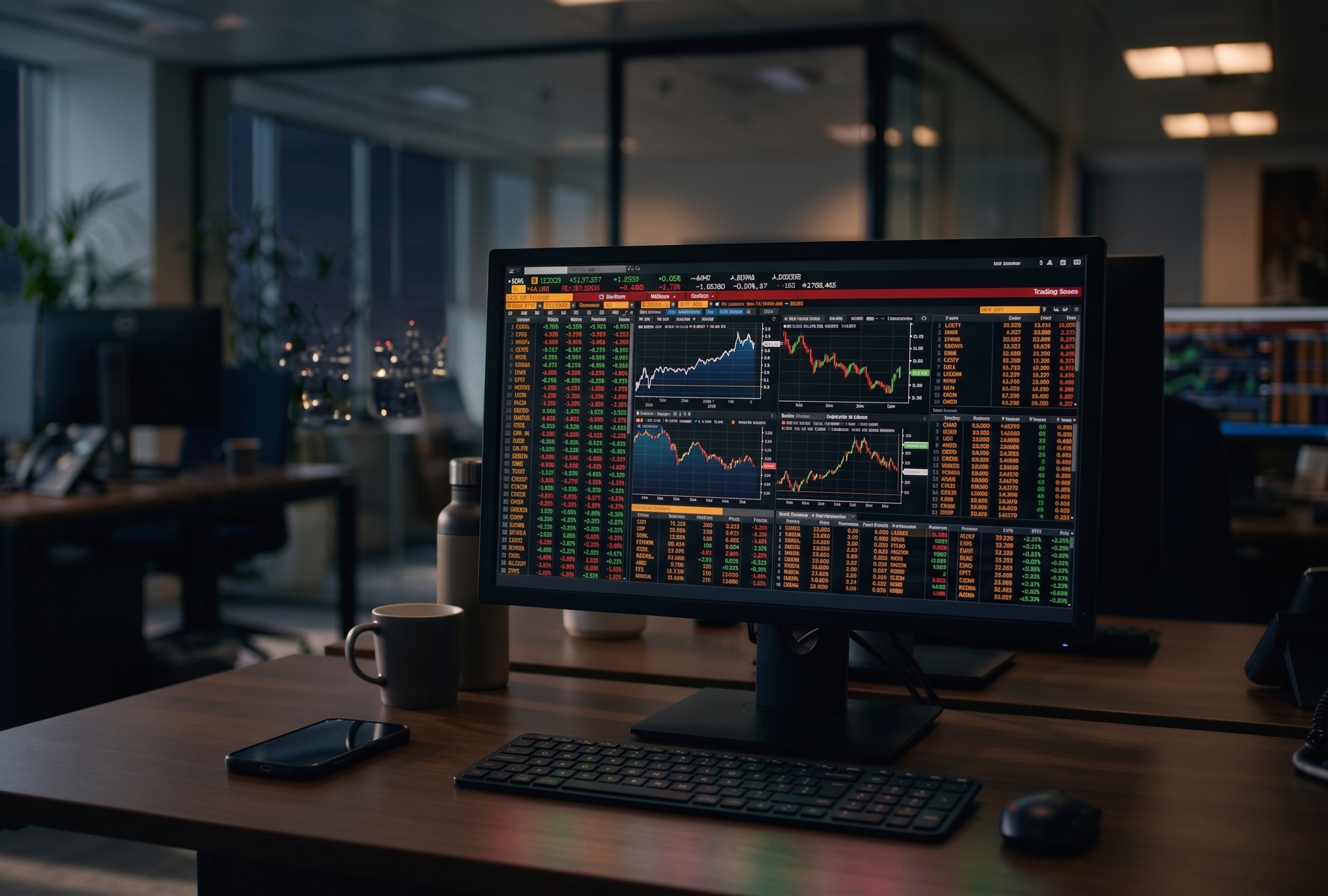

When a confidential deal file or trading position surfaces where it shouldn't, submit the artifact — a photo, printout, even retyped text — and EchoMark's investigation tools identify whose copy leaked. What once took weeks of inconclusive investigation, or triggered a costly external forensics engagement, can now be resolved in minutes, before the trade settles or the story runs.
EchoMark can trace a leak from:
EchoMark's forensic identification is built to stand up to scrutiny. Chain-of-custody documentation, a confidence score, and tamper-resistant watermarking are designed to support evidence that holds up if your firm needs to act — responding to an SEC inquiry, pursuing recourse against a bad actor, or demonstrating due diligence to regulators and limited partners.
Every leak report includes:


EchoMark silently embeds invisible watermarks into every email, document, image, and screen.

You discover a sensitive screenshot, photo, printout, or file outside your organization.

Upload the leaked artifact to EchoMark's investigation tool to identify whose copy leaked, with a confidence score and chain of custody.


How can financial institutions reduce insider leak risk?
EchoMark embeds an invisible, individualized forensic watermark in every earnings preview, merger update, strategy document, and client communication sent to a distribution list. If any version surfaces outside the institution, the source is identifiable in minutes. Because the mark travels with the content itself, it holds up even when a leak happens through a photo, screenshot, or printout that no DLP or access-control system would catch.
How do M&A teams prevent deal documents from leaking?
Deal teams limit exposure with clean teams, codenames, NDAs, and locked-down data rooms, but none of those controls follow a term sheet once a banker, lawyer, or counterparty opens it. EchoMark issues every recipient a uniquely watermarked copy of each CIM, term sheet, model, and diligence file, and recipients knowing their copy is individually attributable is itself a deterrent. If a deal does surface early — in a press report, on a forum, or through unusual trading — uploading the leaked artifact identifies whose copy it came from in minutes, with a confidence score and chain-of-custody documentation for compliance, counsel, or an SEC inquiry.
How do PE firms share investment memos securely?
Private equity firms distribute investment memos, IC decks, and LP reporting across deal teams, operating partners, advisors, and limited partners, where every recipient typically holds an identical file. EchoMark watermarks each copy individually as it is sent, so a memo that surfaces with a competitor, a journalist, or another LP can be traced to the specific recipient who received it. There is no client software and no change to how the deal team works — marking happens automatically through Microsoft Exchange or Google Workspace, or via API. For memos shared outside the firm, EchoMark SecureView adds read-only link sharing with the same individualized marking.
How do venture capital firms prevent confidential portfolio decks from being leaked?
Venture firms circulate portfolio company decks, board materials, and valuation marks among partners, LPs, co-investors, and prospective acquirers — audiences the firm does not control. EchoMark gives each recipient an invisibly watermarked version, so a deck that surfaces on social media, in a reporter's story, or with a competitor is attributable to one recipient rather than to a list of dozens. Because the identifier is embedded in the content itself rather than in file metadata, it is designed to survive screenshots, camera photos of a screen, and printouts. Recipients knowing that every copy is individually identifiable is the deterrent that stops most leaks before they happen.
How do major corporations track down the source of earnings report leaks?
Earnings materials distributed before an announcement are watermarked individually for each recipient — analysts, board members, and internal teams alike. If any version surfaces in a news article, on a forum, or through a trading tip, the leaked artifact is uploaded to EchoMark's identification system, which compares it against every distributed copy and returns the specific recipient in minutes, with a confidence score and chain-of-custody documentation suitable for an internal investigation or an SEC inquiry.
Can a leak be traced if someone photographed a trading screen or printed a report?
Yes. EchoMark's watermarks are designed to survive screenshots, camera photos of a trading screen or printed report, and photocopying, so a leaked figure or document can often be traced to its source even when no file ever left the institution's network.
What should a financial institution do after a confidential leak?
Preserve the leaked artifact exactly as it was found, then upload it to EchoMark to determine whose copy it was. If the material was marked, the investigation returns a confidence score and chain-of-custody documentation the institution can use to brief compliance, legal, and — if the leak involves material nonpublic information — regulators.
How is forensic watermarking different from DLP?
Data loss prevention (DLP) tries to block files from leaving monitored systems and often interrupts legitimate work, yet it can't tell you whose copy was leaked once information is out — especially when it leaves through a photo or a verbal disclosure. Forensic watermarking takes the opposite approach: analysts, bankers, and deal teams keep working normally, and every copy stays individually attributable after the fact. EchoMark integrates with Microsoft Purview for institutions that want both layers.
Can EchoMark protect materials shared with outside counsel, regulators, and counterparties?
Yes. Uniquely marked copies follow materials shared beyond the institution — with outside counsel, regulators, auditors, limited partners, and deal counterparties. Information that travels outside the institution's walls remains attributable to the specific recipient who received it, covering third-party risk that internal controls alone can't reach.
See how EchoMark can be seamlessly integrated with your Microsoft Exchange or Google Workspace to automatically embed invisible watermarks in messages, images, and documents.


